
One of the most important skills for small business owners is developing a comprehensive bookkeeping method.SCORE, the organization of volunteers that helps small businesses, teamed up with Block Advisors by H&R Block for an online webinar explaining why quality bookkeeping is vital.
Led by Sonia Chanani and Sandra Martin of H&R Block, the workshop taught how to turn bookkeeping into a simple, manageable task.
Chanani agreed that bookkeeping can be daunting for a small business owner already juggling multiple responsibilities. The goal is to find a way to make it practical, complete, and easily managed.
“At its core, bookkeeping is the management of business finance. It is a process of keeping detailed records of your financial transactions as they happen, things like money coming in, money going out, paying bills, making payments,” she began. “These transactions occur on a day-to-day basis, and it’s very important that these transactions are recorded into their designated accounts. Every transaction needs to be recorded, and over time, these records tell a story.”
Chanani cautioned that there is a difference between bookkeeping and accounting. She said, while bookkeeping is the financial diary for a business, accounting is the analysis. An accountant uses the bookkeeping record to prepare a financial report, interpret results, and provide insight like whether you are profitable, how to plan for taxes, and where you might improve cash flow.
Martin said the next step for a business owner is to determine how to manage the bookkeeping. She said there are three main options available.
“One is the manual bookkeeping, using spreadsheets and an accounting notebook,” she explained. Second one is the software where you enter transactions into an online program, and the third is hiring a bookkeeper, they handle it for you. There’s no one-size-fits-all.”
She added that the decision can be based on a few factors, including if the business owner has the time to commit to bookkeeping. Another is an individual’s comfort level in managing the books.

“If bookkeeping feels overwhelmingly stressful, that’s a strong signal for you to hire someone that could help you,” she advised. “It’s not a failure; it’s just the help. Your choice is not permanent. As your business grows, your bookkeeping needs change. Many business owners start with spreadsheets and later move to software and then to a professional.”
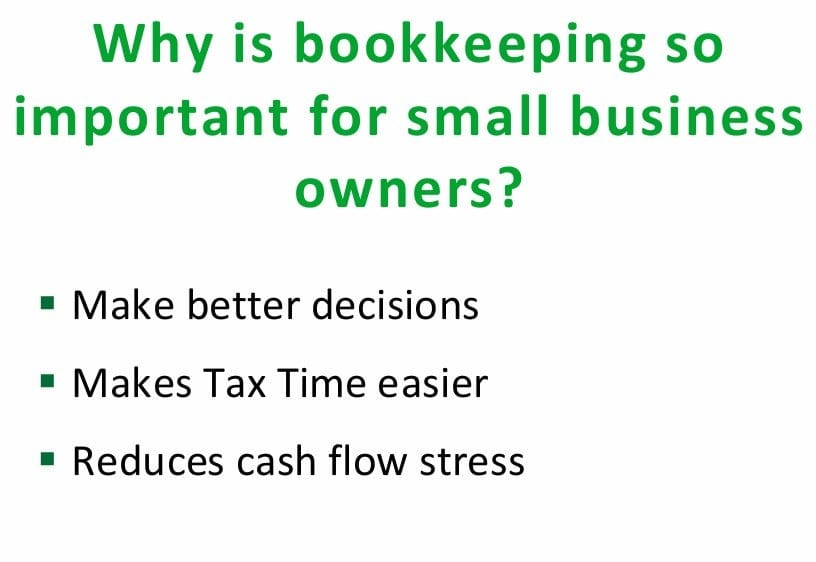
She said another important benefit of bookkeeping is reducing stress about cash flow, which is one of the biggest reasons businesses fail. Bookkeeping creates a real-time process to accurately track when money comes in and when bills need to be paid. Having that information gives a business owner time to adjust cash flow before it turns into an emergency.
The method of bookkeeping can also have an impact. Chanani said the choices are single-entry and double-entry.
“With a single-entry bookkeeping system, you’re essentially tracking just two things: money coming in, money going out. You are not tracking assets in detail. You are not really tracking liabilities,” she said. “This system works well for very small businesses, especially those that don’t have inventory loans or are not moving parts. If your business is simple and your transaction volume is low, single-entry bookkeeping can be practical and easy to maintain.”
Double-entry bookkeeping is more structured and meticulous, she added. Double-entry tracks assets, liability and equity in addition to the basic income and expenses. The system a business owner chooses affects how clearly they can see what’s happening with finances and how well bookkeeping can grow with the business.
SCORE has an office in Aiken. Learn more at: https://www.score.org/greateraiken