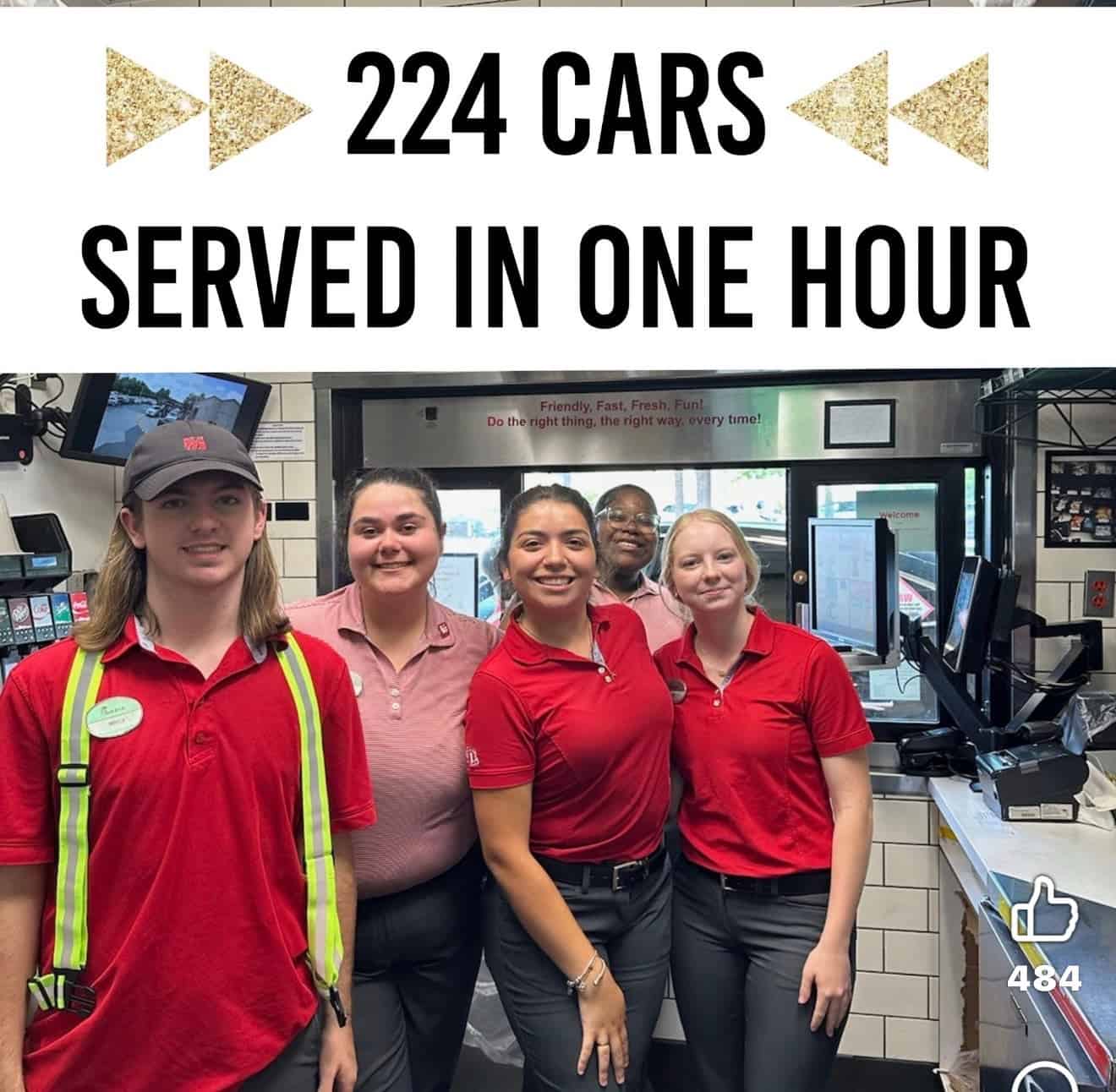
Publisher’s Note: There are so many reasons to love what Chick-fil-A does. The Gordons go to the Mullins Crossing location weekly. I found this photo from 2 years ago! From the time I get “in line” until I have the food, it’s maybe 10 minutes! Great food. Great service. Every time.
RICK: As consumers visiting an establishment for a service, we often find ourselves waiting in line. Whether it is at a drive-thru for a fast food restaurant, placing an order at a fast casual restaurant, checking out at the grocery store, or in the waiting room prior to seeing a doctor or dentist, our experience is often less than optimal due to how much time we have to wait prior to successfully receiving our service.
While such lines are irritating to us, they can be far worse than irritating to businesses. They can lead to lost revenues at the time of the lines and the potential loss of future business. This is why our fourth and final lesson in Augusta Business Daily’s Mini-MBA for the month of March is “Reducing Lines in Service Environments.”
Before we can consider how to shorten or reduce lines, we must first understand why lines are formed. The most obvious and straightforward reason that lines form is that customers arrive for service at a rate faster than the serving company has the capacity to serve them. For instance, during the peak lunch time at a fast-food drive-thru, if cars arrive at a rate of three per minute but can only be serviced at a rate of two per minute, the line at the drive-thru grows at a rate of one car per minute. After a mere ten minutes, there are ten cars in line. A less obvious cause of lines is the variability in the time it takes to serve customers, even when, on average, the serving company may have more service capacity than the arrival rate of customers. Lines happen when multiple customers who take long to serve arrive at similar times for service. For instance, when I was recently in line in a convenience store waiting to pay for my soft drink, customers ahead of me were buying lottery tickets and vaping products, which took much longer to process than customers like me. Therefore, the high variability in service times caused lines to form.
When lines are growing because of the two reasons stated above, three things could happen with customers or potential customers, and unfortunately, two of them are bad. The good result is that you offer a service that is so good that customers choose to wait until they receive their services. The two potential bad results are called “balking” and “reneging.” A customer balks when he or she sees the length of the line and decides the wait seems too long, and never enters the line and goes somewhere else for the service they desire. The customer who reneges enters the line, but after spending some time in the line, he or she runs out of patience and leaves the line and goes somewhere else as well. In both cases, the business loses the revenue that would have been captured from the customer who balked or reneged and runs the risk of that customer not returning in the future based on this experience.

Consistent with our last three Mini-MBA lessons, I provide you with three key takeaways on how to reduce waiting lines at your service business:
1. Have enough capacity (service rates) to meet demand (arrival rates), particularly at peak times
As noted above, lines form primarily when customers arrive faster than you can service them. The most obvious solution to this is to add more capacity during peak arrival times. This is a good solution, but often not cost-effective and potentially not practical due to space limitations and/or labor availability. So, another good method is to move some of your demand from peak times to less busier times through promotions, discounts, and other incentives. Restaurants do this with “Early Bird Specials,” bars with “Happy Hours,” theaters with matinees, and grocery stores with Wednesday discounts for senior citizens. All of these incentivize some customers to move their business to non-peak times.
2. Manage Customer’s Waiting Time Expectations, Perceptions, and Reality
As I always tell my students, while goods are consumed, services are experienced. So, you want to make your customer’s service experience as positive as possible. There are several ways to do this in terms of waiting lines:
- Manage expectations by providing realistic (or maybe overestimating) waiting times to the customer. If they receive their service sooner than their expectation, they will be pleasantly surprised. However, beware of overestimating too much, as that may cause balking.
- Provide customers with distractions that may allow their waiting time to feel shorter. This may include free coffee and soft drinks, televisions, or games to pass the time.
- If space allows, have customers line up in a single line that goes to multiple servers rather than having a line at each server. The reality is that things will go faster when you “pool” variability, and there is a perception that the customer is going more quickly if he or she is moving more soften.
- Train your people providing service to help reduce the variability in their times to provide service.
3. Utilize Everything in Your Tool Kit to Reduce Manage Arrival Rates and Service Times
If your service has the luxury of being able to take appointments or reservations, definitely use those to manage the arrival rates of customers. Even if you do not want to take reservations, allow customers to join a wait list to help you better anticipate arrivals. One of the best ways of reducing service times is to attempt to do as much preprocessing of customer service as possible. For instance, that is why most health care providers are trying to have you do an online check-in to reduce service times at the provider location.
This wraps up your March Mini-MBA brought to you by the Augusta Business Daily. I hope each week’s takeaways provided you with information you could apply to your business right away, and you received that without having to pay any tuition or taking any tests. Class is dismissed, and in April, we will return to some familiar ground, such as business lessons from baseball and the Masters, and examining how local, regional, national, and world events impact your business.