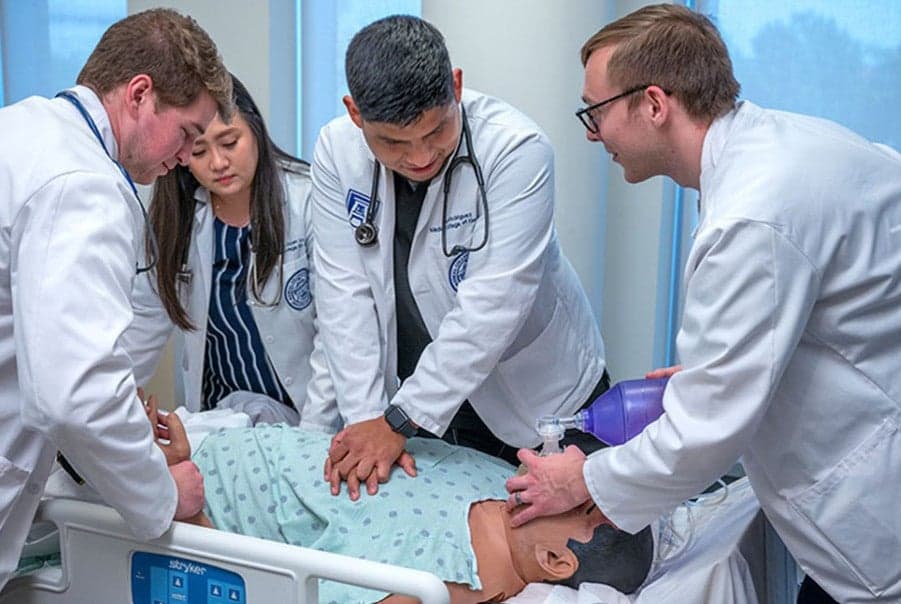
The Medical College of Georgia (MCG) is continuing its more than 200-year mission to train doctors, now targeting the need for physicians in rural Georgia.
Some of Georgia’s 159 counties in rural areas have no physicians or lack specialties such as pediatricians and OB/GYNs. Of that, 143 counties are designated as Health Professional Shortage Areas (HPSAs). Dr. David Hess, Dean of MCG, said those areas are known as health deserts or physician deserts.
The National Institutes of Health (NIH) estimates 20 percent of Americans, that’s more than 50 million people, live in rural areas. However, roughly only 9% of physicians practice in those areas.
Hess said they have developed three ways to try to attract individuals to the medical field.
“One is to recruit from rural areas. Second is to train them in regional campuses. And the third is to develop more residencies in rural areas,” he explained for ABD. “But all those things fall short, because we still, not just in Georgia, but throughout the country, it’s just hard to get people to practice in rural areas.”
According to the NIH, part of the problem is attributable to doctors choosing to remain in more urban areas near where they trained.
Hess agrees.
“If you do medical school at a regional campus or train in a rural residency program, you’re more likely to practice there.”
Hess said that is where the Regional Campus Pathway Program comes into play. This is just the second year of the program.
“We look for students during the admissions process who are willing to go to a rural campus, the Southwest campus based in Albany, or the Northwest campus in Rome,” he said. “We admit them with the agreement that they will go to those regional campuses, that they’ll want to train there. This is a way to get people interested in rural Georgia care, and then they get a little boost in admission.”
Kelli Braun, the Senior Associate Dean of Admission, developed the regional campus approach, along with the AIM (Assurance in Medicine) program, which is also in its second year. MCG representatives go to rural colleges and universities, such as Coastal Georgia in Brunswick and Columbus State University in Columbus, looking for rising juniors and seniors with an interest in attending medical school.
“We help them with MCAT, that’s the admissions test for medical school, and then grades. And we mentor them,” said Hess. “This is the way to identify students that traditionally don’t go to medical school and just give them a little boost by just preparing them better for the admissions process in medical school. Because, unfortunately, medical school is still very hard to get into.”
It also boosts MCG’s admissions. With more than 300 students, MCG is one of the largest medical schools in the country, yet even they must turn applicants away. This allows MCG to admit students to study at the regional campus.
These are MCG’s latest opportunities to train new medical students, either at regional campuses or with programs to incentivize them to serve in rural areas.
During the recent Rural Prosperity Summit, sponsored by the Georgia Chamber of Commerce, Dr. Dean Burke, Commissioner of the Georgia Department of Community Health, said he benefited from a scholarship offered at MCG when he attended in the late 1970s.
Burke grew up in Bainbridge and considered joining the U.S. Army to help fund his education, until he learned about the scholarship at MCG.
“I found out about what they called at the time, “the country doctor scholarship”, and you had to commit to going back to a rural community,” he explained. “I signed up for that because my plan all along was to go back to where I was from.”
Burke said he understands medical students’ interest in practicing in a larger, more urban area. He said he felt it when he completed his residency and had an offer from a new hospital in Metro Atlanta. However, his rural roots won out, and he returned to Bainbridge, where he practiced for nearly 30 years before entering politics.
During those years, Burke saw firsthand the difficulty in attracting doctors, particularly those just graduating, to rural areas.
“We talked to 20 before we got one that would agree to actually come for a visit. But, you know, once they were there and saw the positives of being in a small town, so much community support for you, it was a great way of life, great place to raise a family,” he said.
The Regional Campus Pathway Program and AIM enhance the pathways MCG started in 2020. Students who enter the Peach State Scholar and the MCG 3+ Primary Care Pathway complete their education in three years and receive scholarships in the second and third years. In return, they do their residency in Georgia and commit to practice medicine in the rural counties. To date, three classes have graduated and started their residency, with two more cohorts in school.