
About 50% of CSRA counties are growing, and 50% are not.
I usually use Metropolitan Statistical Area (MSA) data for this column, as it is released more frequently than county-level data and is more up-to-date. However, I was giving a talk to the Central Savannah River Area (CSRA) Regional Commission on Friday, so I dug into some county-level data.
The CSRA Regional Commission is a group of area economic development organizations from 13 Georgia counties: Burke, Columbia, Glascock, Hancock, Jefferson, Jenkins, Lincoln, McDuffie, Richmond, Taliaferro, Warren, Washington, and Wilkes. By comparison, the MSA includes Burke, Columbia, Lincoln, McDuffie, and Richmond counties in Georgia, along with Aiken and Edgefield counties in South Carolina.
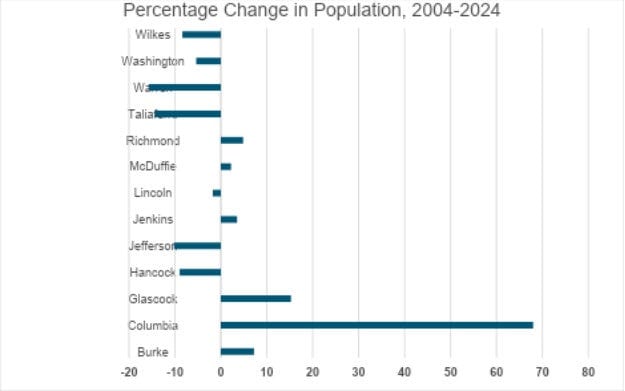
Over the past 20 years, the population has increased in 6 of the 13 counties, with Columbia County having the largest increase at 68%. Four out of the five metro counties saw population increase, reflecting the continued urbanization trend.
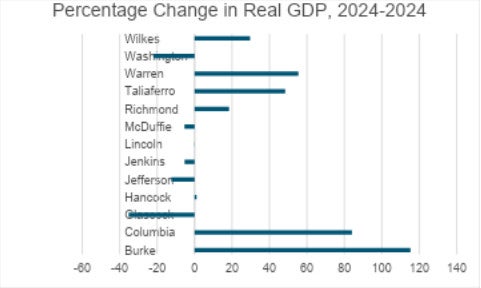
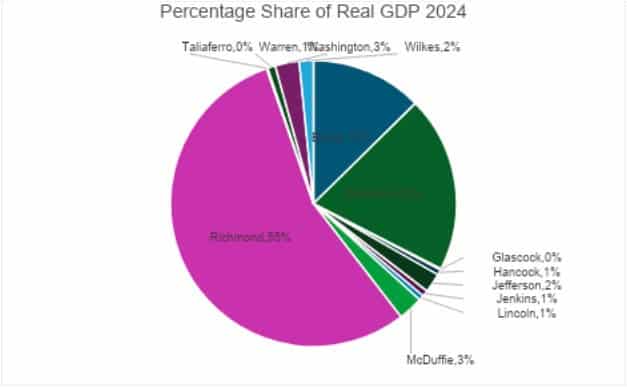
When looking at Gross Domestic Product (GDP), or the final value of goods and services produced in a county, Burke County doubled its output due to the expansion of Plant Vogtle. Eight counties have grown economically over the last two decades, but five have gotten smaller. In 2024, just three counties (Richmond, Columbia, and Burke) accounted for 83% of the CSRA’s GDP.
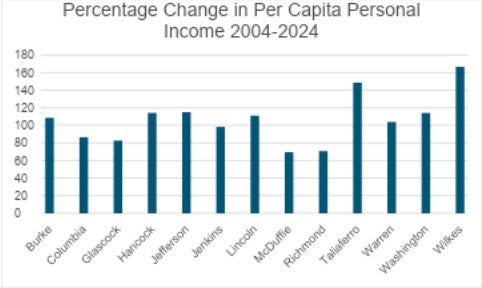
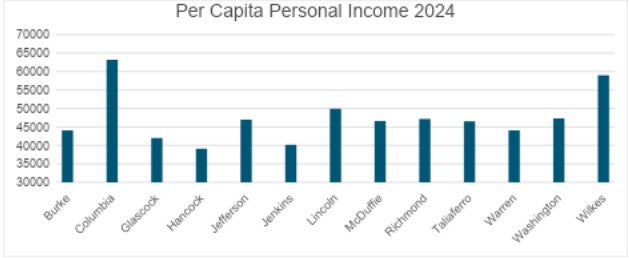
Per capita personal income has doubled over the last two decades in eight, mainly rural, counties. The largest increases were seen in Taliaferro and Wilkes counties. Those counties have the second-highest per capita personal income behind Columbia County.
Overall, the CSRA economy is still dominated by the urban core, although some of the more outlying counties are benefiting from population growth and increases in per capita personal income.