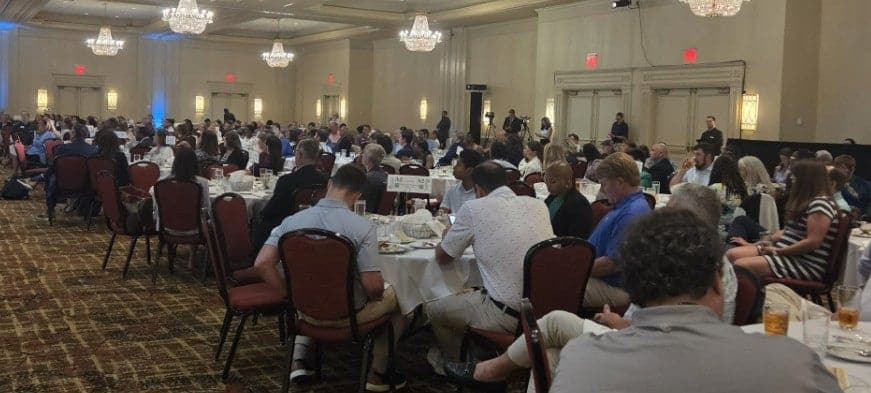
A topic generating national headlines—and local controversy— drew a large crowd to the Augusta Metro Chamber of Commerce’s Member Economic Luncheon.
Dennis Trotter, AMCC Board member, introduced a panel of experts and shared the data center’s impact on his firm.
“Just in our office, that we do for our commercial real estate business, we’ve seen these become very emotionally charged issues on one end,” he began. “But, with the other end being extremely large capital investment in our community, an enormous amount of tax generation for all our various governments that need it, and relief to certain sectors of the tax base that could certainly use it when these things come online.”

Panel members were Jeff Greene, Senior Manager of Economic Development with QTS Data Centers; Khara Boender, Director of State Policy with the Data Center Coalition; and Kerry Bridges, P.E., Region Executive with Georgia Power. Chamber President and CEO Angie Cox moderated the discussion.
“It is very important that we discuss and that we educate, and that’s the role that we are taking in this panel discussion,” she explained. “As we continue to see expansions in this industry and in the infrastructure and the logistics and the partnerships and the economic impact that data centers have on the state and on the region, we wanted to make sure that we were providing our members with the opportunity to learn as much as they could about that.”
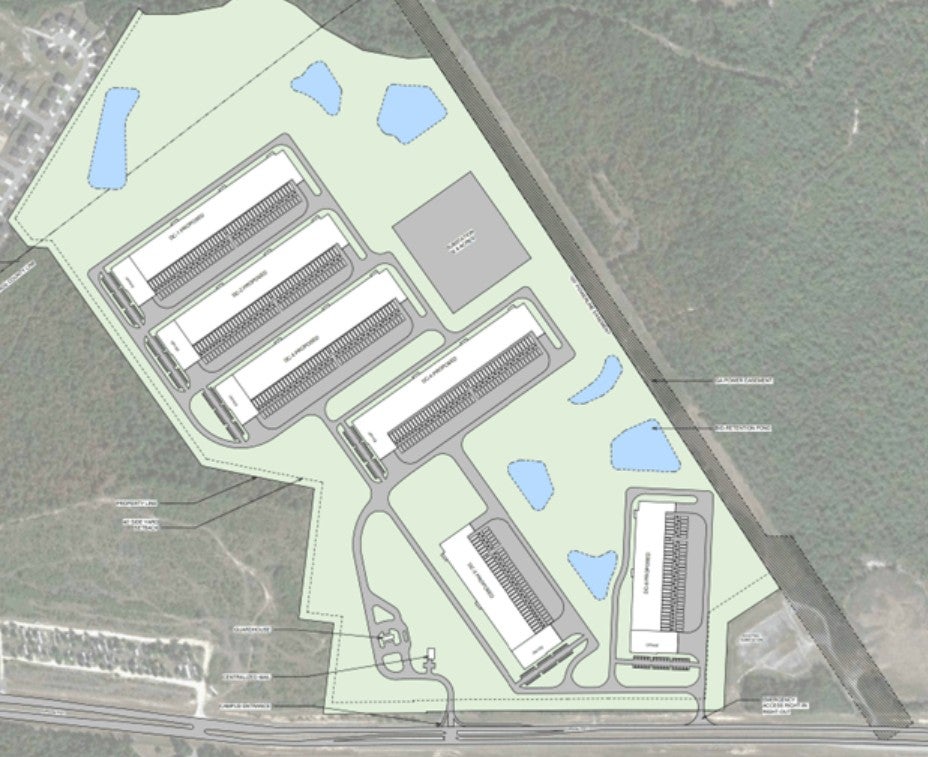
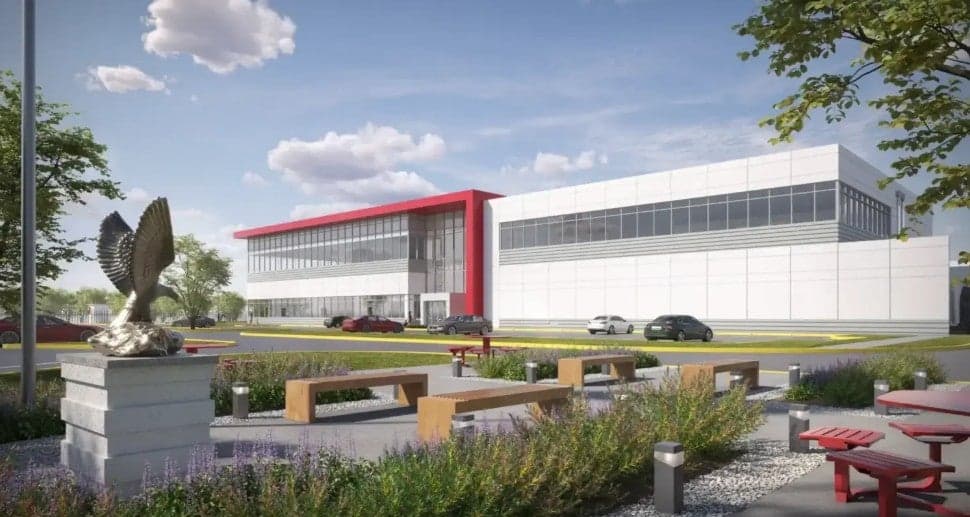
Still officially known as Project Eisenhower, it was first proposed in 2022 by T5 Data Centers but ultimately taken over by Virginia-based QTS. Preliminary drawings show a campus roughly twice the size of the Augusta Mall property, with six buildings.
“What you should expect from us is that when we’re getting to full operations of all six buildings here in Augusta, that we’re going to use about 18,000 gallons of water a day, and that is to have water for our employees, flush toilets, wash hands, do dishes, all the things that you would do in a typical office building,” said Greene.
He said that it will be accomplished by using a closed-loop system to provide the cooling needed to protect servers.
“It basically uses the equivalent of about one Olympic-sized swimming pool to fill a typical data center, and then it stays in that closed loop for the rest of its use,” he said. “It’s like a giant radiator, and it will just keep circling, cycling through, and the water is heating and cooling consistently over and over and over again.”
In addition to an area’s water supply, data centers have also come under criticism for the impact on electric power and rates. Bridges explained that Plant Vogtle’s four units generate 4,500 megawatts of electricity, enough to power 2.8 million customers past the year 2100.
“Georgia is so attractive to manufacturers and economic development and data centers because Georgia Power is a vertically integrated utility,” he said. “What that means is that Georgia Power owns, operates, and maintains not only the generation plants, but also the transmission plants and the distribution plants. So, companies like Jeff’s company are dealing with one entity to generate, transmit, and deliver that power, and speed to market.”
Cleanview, based in Colorado, tracks where U.S. power infrastructure and data center developments are being built. Its website says there are 17 data centers currently operating in Georgia with a capacity of just over 1,000 MW. Another 83 projects adding more than 9,200 MW of additional capacity are in the planning stage.
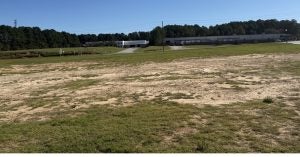
Project Eisenhower will be at 2883 Gordon Highway. The site is bracketed by Hayne’s Station and Captain’s Corner neighborhoods near Fort Gordon.
QTS and the City of Augusta sponsored a community forum in February in an attempt to address residents’ concerns. Another forum is scheduled for June 24, 5:33-7:00 p.m. at Belair Elementary School at 3925 Harper-Franklin Avenue.
More information is available at the QTS website: https://q.com/data-centers/augusta/