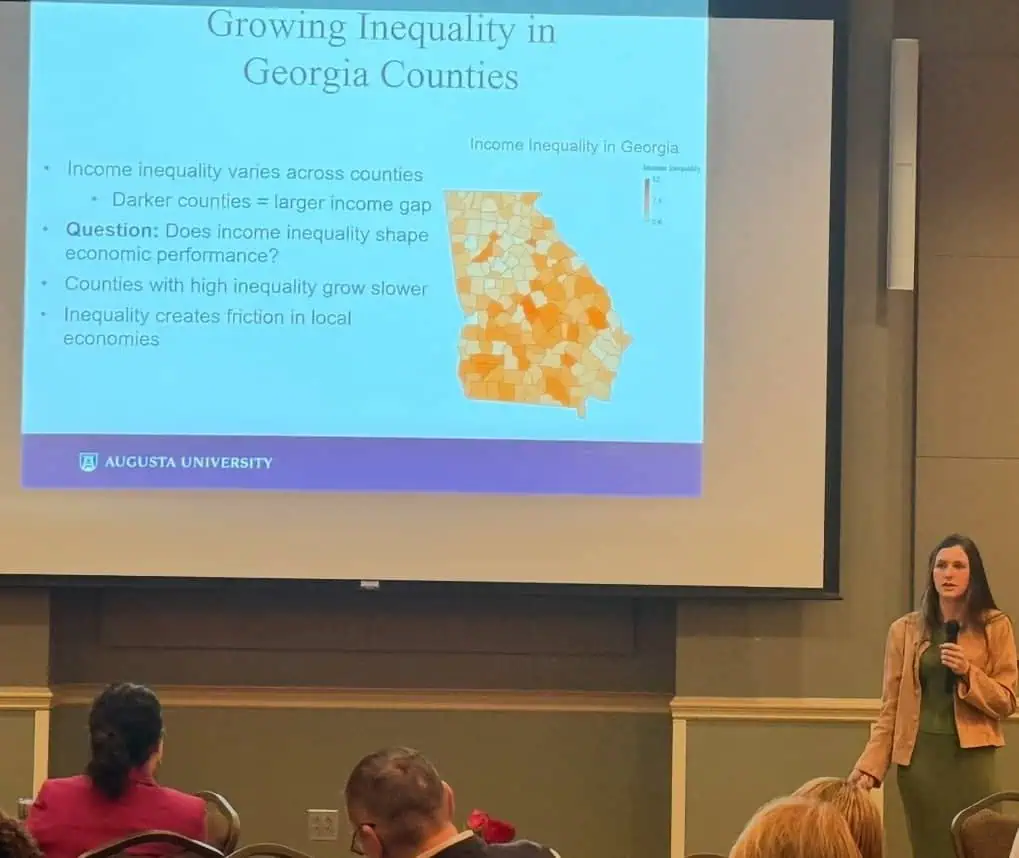
Yesterday, I gave my economic forecast with the help of two undergraduate economics students, Kacey Axon and Brandon Day. Due to the 40 + day delay caused by the feds shutting down the government, we’ve had an absence of local economic data for several months.
This week, Kacey and I concentrate on long-term growth and summarize her research.
Next Tuesday, we will cover Brandon’s analysis.
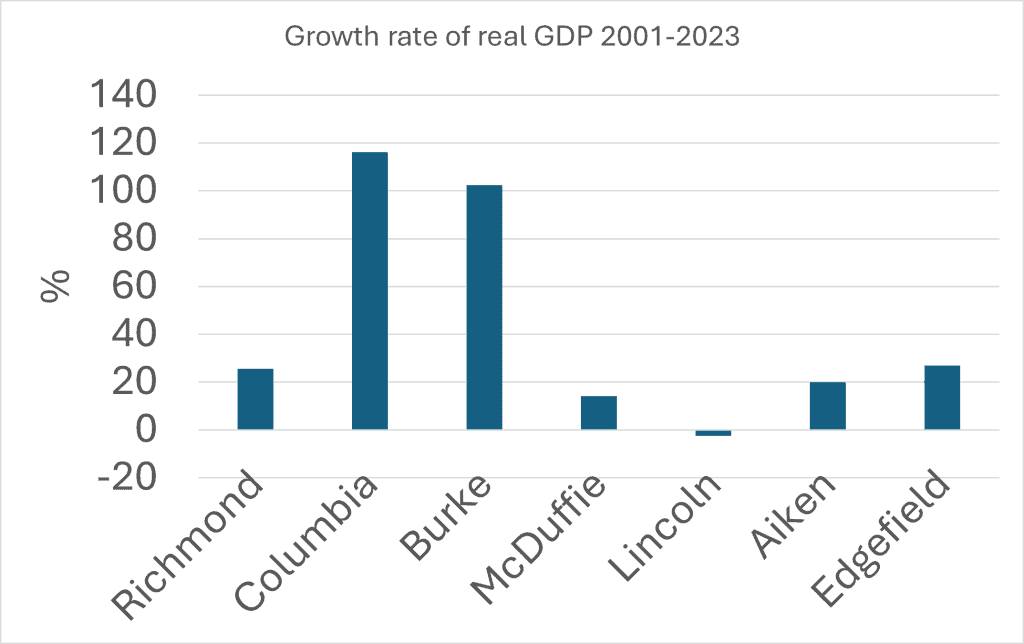
In economics, when we talk about growth, we talk about an increase in real GDP. GDP is gross domestic product and is the total market value of all final goods and services produced in an area in a year. The Augusta metro area real GDP has grown at 1.5% annually since 2001, compared to 2.2% for the United States. The growth is not evenly spread across the counties of the MSA, with Columbia County and Burke County doubling in size while Lincoln County has gotten smaller.
We examined factors that influence this growth rate across all counties in Georgia from 2011 to 2020. Rural counties grew slower than urban counties, but interestingly, lower income inequality in a county was associated with higher growth. We went on to see what factors, therefore are associated with lower income inequality. This analysis was conducted at the state level to allow for a measure of redistributive tax rates. Maybe surprisingly, a more redistributive tax system and a higher minimum wage did not have any effect on income inequality. Factors that were associated with lower income inequality were more education, both college-level and 3- and 4-year-olds. Counties that had a more diverse economy had lower inequality.

The implications for policy are clear. Pre-labor market policy (educating 3- & 4-year-olds) is better than post-labor market policy (higher marginal tax rates) in terms of improving income inequality. Increasing opportunity, both in terms of education and a competitive labor market, can improve income inequality. But, reducing income inequality is not a goal in itself; lower income inequality also drives economic growth for all.