
The Georgia Chamber of Commerce Foundation is keeping the state’s in-demand career paths and training to prepare for them top of mind.
The foundation has released its latest inaugural Career Track Profiles. It is a one-stop workforce resource available to students, educators, employers, workforce professionals, and policymakers.
“Utilizing the state’s first unified High Demand Career List, our team was able to develop an actionable tool to guide students and job seekers with the next steps to find employment in our fastest-growing, high-demand careers,” said Daniela Perry, Executive Director, Georgia Chamber Foundation, in a news release. “This resource highlights the numerous paths that can be taken whether the individual is a high school student or an adult making a career shift and aids Georgia businesses in filling their greatest talent needs.”
The High Demand Career List was created in May 2024. It called for the creation of a list of high-priority jobs to keep Georgia competitive. Career Track Profiles will provide updated career opportunities in the state’s fastest-growing industries, and the training needed for the positions.

Julie Goley, Director of Career Services at Augusta University (AU), said that with Georgia consistently ranked as the number one state for business in the U.S., regular updates to the lists are necessary to keep workforce training on target. It also benefits institutions of post-secondary education.
“Certainly, as a career educator in the state of Georgia in higher ed, I appreciate seeing even more synergy across our Technical College System of Georgia (TCSG) and the University System of Georgia (USG), which is another to me a win because our students are our students and our employers are our employers, and we’re all trying to meet those same needs,” she told ABD. “More intentional pathways and work at the high school level, but also what we’re seeing even in postsecondary for degree completion skill building, we’re all moving in the right direction, and that’s encouraging to see.”
The Occupational Profiles in the latest report highlight six in-demand careers:
- Machinists
- Industrial Engineer
- Electrician
- Electrical Power-line Installer and Repairer
- Electrical Engineer
- Aircraft Mechanic & Aircraft Technician
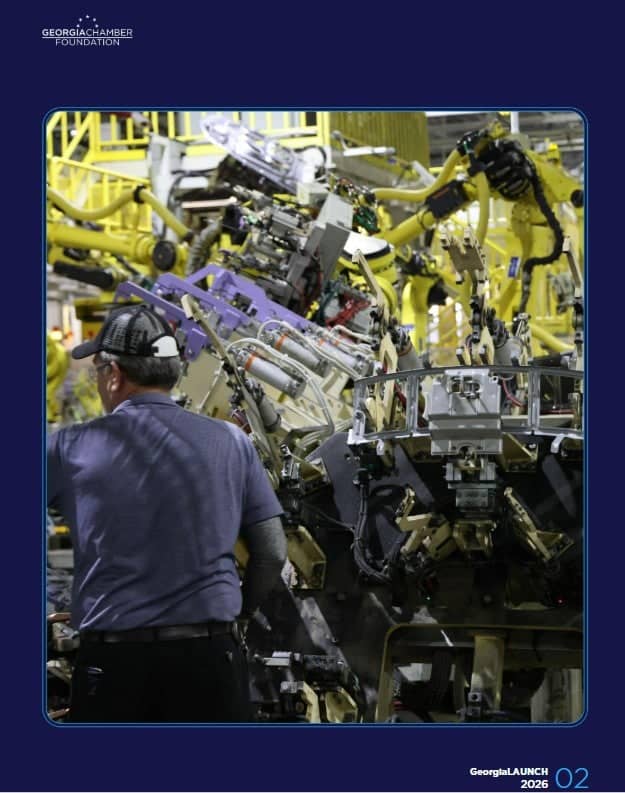
Each career description includes the recommended education and training needed to secure a position. It also includes a review of what skills in each career overlap among the six categories. It is hoped it will develop ways to streamline training and upskilling.
That can be a significant benefit. Goley said careers and requirements are always shifting. The foundation’s new report ensures Georgia is ready to pivot as needed.
“There are so many fascinating pieces of workforce development right now,” she said. “With the advances of AI and technology, what does that mean, and how does that continue to shape things? I see it’s more about being able to adjust and refine your skills for life. And certainly, as we look ahead, we’ve got to be ready to pivot for workforce development in industry, in education, and in all facets of what this is and what’s ahead.”
Metro Augusta has demonstrated the need to be flexible and adapt to changing landscapes in education and workforce needs. Since the influx of cybersecurity and corresponding ancillary businesses moved to the region, both Augusta Technical College and AU have created new pathways.
“Even the consolidation to create a new university,” Goley noted. “Just Augusta University as an example. We’re the state public healthcare university, so we have a high mission across the state of Georgia. But in some of our other pockets, it’s very centric to more of a regional base within the state. We have to constantly look at how our program offerings are supporting those, and our mission as an institution to be meaningful to the state and to the workforce to come.”
Goley added it may be wise to expand the ways education and training programs are reviewed. She said recent steps offering new degree programs are in the right direction, but there is a need to be sure those are targeted to meet the demand where it exists.
“As an employee of the University System of Georgia, we need to be looking more geographically at where our industries are and how to respond to those needs and do work-throughs of degree offerings,” she said. “The business of education is expensive, and the consumers are our customers, and we’ve got to figure out how to best leverage all of those things.”
The report from the Chamber Foundation combined labor market information with career planning resources. The research supports the goals of Georgia | 2050, the strategic plan to steer economic growth, infrastructure investments, and workforce development.
The latest report is available at: www.gachamber.com/georgialaunch/#occupational-profiles