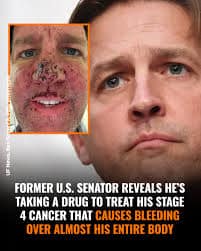
In mid-December 2025, 54-year-old Ben Sasse was diagnosed with metastatic, Stage 4 pancreatic cancer. His cancer has spread to his liver, lungs, and vascular system. When diagnosed, he was given a life expectancy of four months. As of late last month, a new clinical trial drug had reduced his tumor volume by 76%, and he had already outlived that predicted life expectancy.
If you are not familiar with Mr. Sasse, he has lived a very accomplished life. He graduated from Harvard in 1994 with a bachelor’s degree in government and from Yale in 2004 with a Ph.D. in history. After various private and public sector positions, in 2014, he ran for the United States Senate representing his home state of Nebraska, winning the seat with 64.4% of the vote, and winning reelection in 2020 with 62.7% of the vote. Mr. Sasse resigned his Senate seat two years into his second term to become the President of the University of Florida. His term as President began in early February 2023, but he stepped down at the end of July 2024 due to his wife’s diagnosis of epilepsy and memory issues. After stepping down as President, he continued to teach at the University’s Hamilton Center for Classical and Civic Education.
Despite such an accomplished life, Mr. Sasse appears to be making his greatest contributions as it nears its end. He can be read, heard, and seen in various media outlets discussing his thoughts on the current state of American society and politics and how we can improve our long-term societal health. I strongly encourage you to read his recent opinion pieces in the Wall Street Journal. In addition, his “60 Minutes Overtime” interview is compelling viewing.
At this point, you are probably asking yourself what relevance Ben Sasse’s thoughts have to me as a business or organizational leader in the Augusta area. As local leaders, we all have a vested interest in making our communities better places to live and helping our neighbors lead happier and more fulfilling lives. So, in the remainder of today’s column, I am going to highlight some of the themes of Mr. Sasse’s recent interviews and indicate how we can all aspire to help bringing these ideas to life to make for a more fruitful society.
- Importance of Community: Sasse has stressed that we all need to interact more with our families and neighbors. This is similar to Michael Smerconish’s encouragement of “mingling.” Technology has made us all more insular. As business and organizational people, you can create more community by becoming more connected to your employees and your customers. From a personal perspective, I try to make each of my classes a community. We all (instructor and students) introduce ourselves professionally and personally at the start of the semester. I make sure I know all my students’ names (up to 40 in a class). This provides an environment where everyone feels engaged and supported, leading to better performance.
- Humility, leading to Learning: Sasse indicates that we all need more humility, which will allow us to learn more. Understanding that we do not have all the answers allows each of us to learn, providing an environment in which all are improving. Too much overconfidence tends to stifle growth. As leaders, our responsibility is to be role models for humility, which will enhance our organizations. Remember, humility is not believing that you are incapable. Rather, it involves accurate self-assessment, recognizing one’s limitations and strengths without vanity, and prioritizing others above oneself.
- Self-Reliance, Work, and Delayed Gratification: Sasse makes the point that we need to do a better job of championing a culture of self-reliance and the dignity of work. It is imperative to teach future generations to be responsible and industrious and that anything worth achieving takes time (i.e., delayed gratification). There has been a slow degradation in our society of self-reliance, responsibility, and delayed gratification. It is our job as leaders to reverse this trend by demonstrating the need for these characteristics in our businesses and organizations.
- Work of the Future: Sasse makes several comments on how jobs and careers will be much different in the future. Those who will be successful are those who learn how to use technological tools rather than outsourcing to those tools. They will also include those who have the “scar tissue of rejection.” Sasse indicates, and I heartily agree, that people who have sales experience tend to go on to success because of that built-up scar tissue. As organizational and business leaders, we need to demonstrate to our people that failure is not fatal, but rather a learning opportunity on the road to success.
Mr. Sasse has more insights on lifelong learning, adding value to others, spirituality, and gratitude that you can read/hear more about in his columns and interviews. It is unfortunate that Mr. Sasse will likely leave us much too early, but his legacy can be the lessons he provides that those in the CSRA and others can pass on to make society a better place.