
The National Retail Federation (NRF) released a look at how they expect consumers to shop for this holiday season. NRF said that holiday shopping runs from this weekend to Dec. 31.
NRF Chief Economist Mark Mathews and Vice President of Industry and Consumer Insights Allison Zeller looked at the recent NRF holiday sales forecast and expectations for consumer spending. Their findings were announced in a webinar ABD attended.
“In our consumer study, we see 56% are reporting that the economy and the state of the economy will impact them negatively in their shopping plans for the holiday season, and 64% are expecting that prices are going to be higher than what they expected from last year,” began Zeller. “But celebrations and spending plans are continuing to maintain the same rates that we’ve seen for the last decade or so.”
The NRF is forecasting that retail holiday sales will increase by 4.2% this year, over 2025 figures. The industry group is anticipating sales will hit the $1 trillion mark for the first time.
However, Mathews said consumers are watching the price of gasoline, while businesses are monitoring diesel costs’ impact on shipping.
“The estimates I’ve seen are that diesel prices, if they continue, are going to add about 0.4 percentage points to inflation,” he explained. “We don’t necessarily know whether those costs are going to be passed along to the consumer,” adding that cost increases from higher tariffs were generally absorbed by the businesses.
“It is such a highly competitive industry with transparent pricing that it is very difficult to pass costs along. So, I think the big question when it comes to diesel prices is how much of that is actually going to make its way into the economy and is that going to really have an impact on the consumer.”
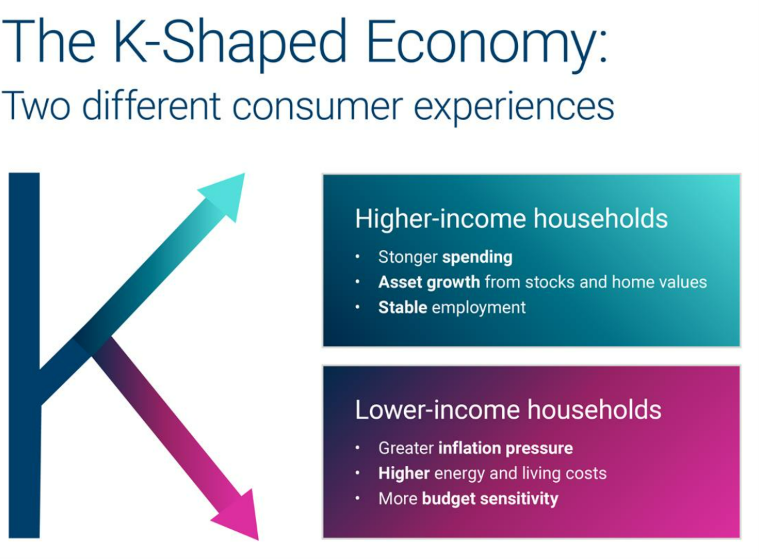
Mathews said they also studied the impact of the K-shaped on consumers. That is when one segment experiences an increase in wealth, representing the upper arm of the K, while the lower arm illustrates financial strains from lower wages and declining purchase power.
“Higher income households tend to be spending more; their growth is faster than lower income households,” said Mathews. “I think the challenge is that, as we look forward into the future with more inflation, how the lower-income household is going to perform as they head into the holidays.”
The study also looks at the number of consumers choosing to shop in-store or online. Zeller said they anticipate a slight decline this year.
“Fifty-three percent of shoppers plan to shop online for the holidays, but that’s down from 60% in 2020, and has been on a steady decline for a few years,” she said. “The reasons why they’re shopping more in store is they prefer to see and evaluate gifts and other holiday items before making a purchase.”
To facilitate planning, NRF anticipates consumers will turn to AI to search for gifts online. They will determine stores with products they want along with the best deals.
NRF also projects there will be a hit from inflation after the holiday season. In the meantime, Mathews expects consumers will continue to shop.
“Consumers don’t feel great about the economy, about inflation, but they’re not spending their sentiment. They’re not spending their psyche,” he said. “They’re spending what’s in their wallets right now, and obviously these are important events. This is an important time of the year, and we do expect consumers to be stepping up.
The webinar is available at https://nrf.com/video/2026-winter-holiday-consumer-outlook-webinar.