
Retailers in the CSRA and elsewhere should have a successful and profitable holiday shopping season this year.
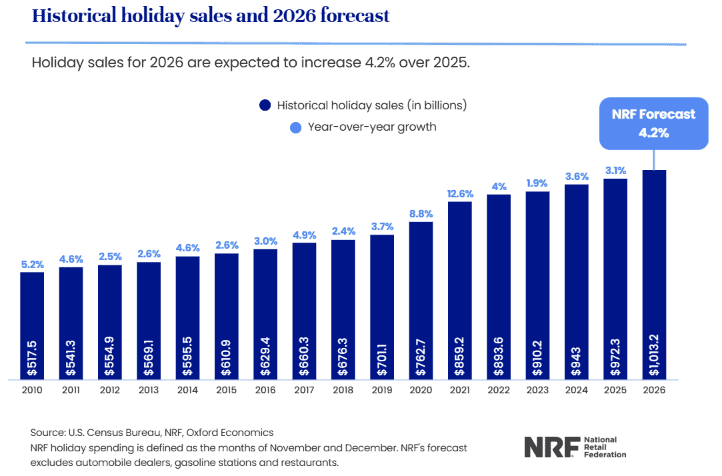
The National Retail Federation (NRF) has released its annual report predicting retail sales during November and December. It anticipates a 4.2% growth over 2025, translating to $1.013 trillion in consumer spending. Last year’s sales rose $972 billion, or 3.1% over 2024.
During a recent media briefing, attended by ABD, NRF President and CEO Matthew Shay said consumers have consistently demonstrated the importance of holidays and that spending on loved ones remain priorities.
“We continue to be very impressed with the resilience that consumers have demonstrated as they continue to spend and power our economy, and we expect that strength to carry into our November-December holiday period, even as I think we all acknowledge, households continue to navigate persistent inflation and uneven confidence about the economy,” said Shay.
Shay said retailers are ready for the season and will offer competitive prices and choices that will work within everyone’s budget.

NRF Chief Economist and Executive Director of Research Mark Mathews agreed, adding that while optimistic, their organization is mindful that inflation, rising gas prices and pressure on household spending will affect consumers differently across income groups.
He believes there are five key factors playing a role in the outlook for holiday spending:
- Inflation
- Income
- The labor market
- Household wealth
- Consumer confidence
“Even though the ability to spend varies dramatically by income group, it’s important to stress that we do expect households to continue to prioritize spending on family, friends, and loved ones,” said Mathews. “As we head into the holiday season, we expect consumers to remain deliberate and value-conscious in their choices, even as they prioritize gifts and celebrations.”

He added retailers are watching the impact diesel fuel prices have on their shipping costs. He anticipates, just as with increased tariffs, retailers will look for ways to absorb those costs, rather than pass them along to consumers.
“Surging prices are putting upward pressure on important gifting categories, particularly electronics,” he said. “As we head into the holiday period, if gas prices remain higher, we do expect that this will have a larger impact on households at the lower end of the income spectrum.”
Retailers have started hiring seasonal workers to help them through the Nov. 1 – Dec. 31 holiday shopping season; however, Shay said hiring may be slightly lower than last year.
“It’s our expectation that retailers will hire between 325,000 and 375,000 seasonal workers, and that really reflects modest change from last year, 2025, when retailers added 356,000 jobs to meet holiday demand,” he explained. “Retailers continue to operate their businesses in this low-hire, low-fire labor market, and retailers will remain careful but responsive in terms of aligning staffing and other resources with consumer demand across stores, distribution, and fulfillment centers, and other operations.”

Before the holiday shopping season kicks off, retailers are anticipating higher sales for Halloween. Consumers are expected to spend $13.5 billion on Halloween costumes, candy, food, and parties. That is an increase over the $13.1 billion spent in 2025.
An estimated 74% of consumers shop for Halloween, compared to just 64% almost 20 years ago. That increase is attributed in part to Halloween turning into more than a one-day event with the rise in trunk-or-treats and costume parades, with adults visiting haunted houses and watching scary movies. More than 60% of consumers plan to hand out candy this year.
The full NRF report on holiday spending is at: https://nrf.com.