
A leading industry organization has checked the trends, conducted surveys, crunched the numbers, and believes spending for the 2025 holiday buying season will top $1 trillion.
Ray Carnes, founder of Recteq in Evans and part-owner, says he can tell already it’s going to be a strong holiday season.
Friends and others are constantly asking, “When will Black Friday sales start?” Carnes says the earlier people ask, the better their season is.
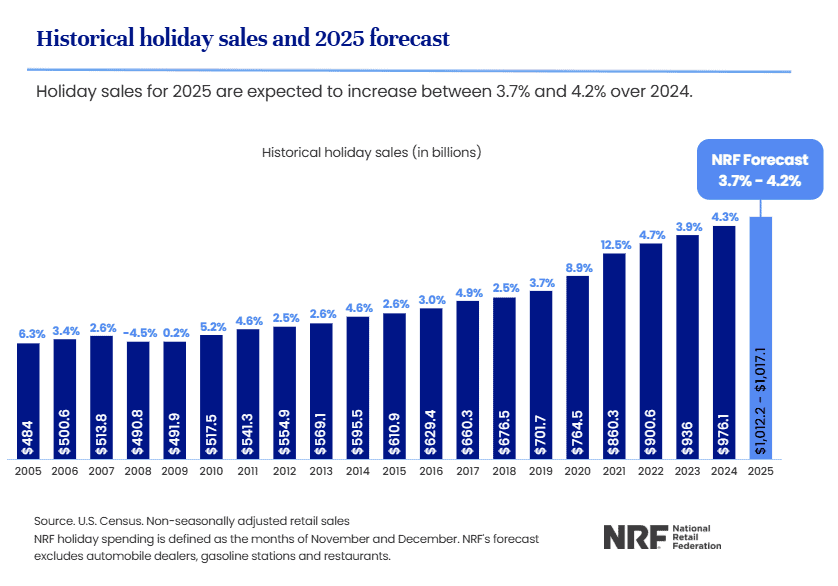
The National Retail Federation (NRF) lists the time between November 1st and December 31st as the holiday shopping season. It believes retail sales will increase between 3.7% and 4.2% this year, pushing spending to between $1.01 trillion and $1.02 trillion. Sales in 2024 grew by 4.3% over 2023 and hit $976.1 billion.
ABD participated in the NRF’s annual media call, where experts broke down the factors it expects will drive holiday sales. NRF President and CEO Matthew Shay said they realize American consumers and the business community are facing uncertainty because of inflation, changing trade policies, unresolved tariff issues, and the government shutdown.
“One of the features of this year is that we see consumers sharing with us their attitudes and their sentiments, which by historic standards continue to be very, very low, and yet they continue to spend and power the economy,” he said. “Just for a little more context, consumer spending currently accounts for more than 68% of our nation’s GDP (Gross Domestic Product), which is the highest proportion in almost 15 years.”
Shay said consumers plan for holiday shopping, essentially building a moat around it to keep it a priority. However, there are signs that consumers are being more price sensitive.
“We know they have adjusted the way they spend month to month. We know they are thinking about things much more deliberately, trading down, looking for less expensive options, trying to find value wherever they can find it,” he explained.

That’s where another of Carnes’ businesses comes in. He is a part-owner of Ray Ray’s car wash. At his newest location on Riverwatch near Washington Road, he’s providing a free $20 gift card to each customer who buys 4 of the $20 gift cards.
“Sometimes it’s hard to find little gifts or stocking stuffers.”
Generating More Revenue with Less
One area showing a decline from the 2024 holiday period is the number of seasonal employees expected to be hired. Last year, retailers hired 442,000 workers to help over the holiday season. This year, it is projected to be no more than 365,000 seasonal workers.

“That may be the lowest level in more than 15 years, which we think does reflect the softening and slowing labor market. But nevertheless, we are confident that retailers will be prepared to meet consumers with the prices, with the goods, and with the convenience savings and value that they’re looking for this holiday season,” said Shay.
Mark Mathews, NRF Chief Economist and Executive Director of Research, said promotions launched by retailers are coming on strong this year, and consumers are taking notice.
“In our most recent survey data, the consumer, actually a larger percentage of them, are holding off for the Thanksgiving weekend Black Friday sales than last year,” he said. “So, we have a consumer that is really out there looking for deals, and we fully expect retailers to respond to that and to make sure that those consumers have the opportunity to buy promotional sales and promotional items now.”
In mid-October, the NRF issued a report estimating how much retailers anticipate their annual sales will be returned this year.
Return to Sender
The prediction is that 15.8% of their 2025 sales will be returned, according to the Retail Returns Landscape. That works out to $849.9 billion. In 2024, returns were 16.9% and totaled $890 billion.
The report also projected returns for the current holiday shopping period. An estimated 17% of holiday sales are expected to be returned, similar to previous years. Forty-nine percent will hire seasonal staff to manage returns, and 39% are extending the window for returns.
The holiday shopping predictions focus on core retail sales and exclude auto dealers, gas stations, and restaurants.
For more information, visit: https://nrf.com/research-insights/holiday-data-and-trends/winter-holidays/winter-holiday-faqs
The full report is at https://nrf.com/research-insights/holiday-data-and-trends/winter-holidays.