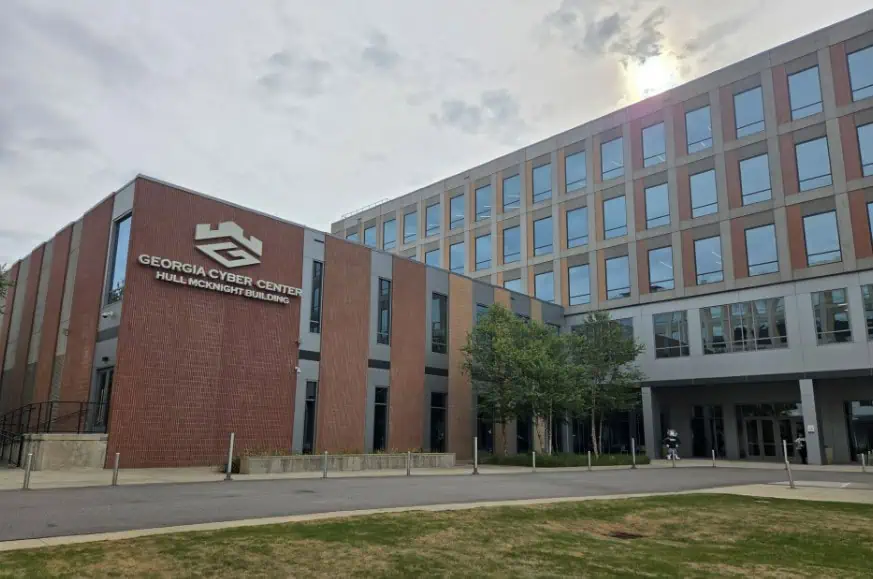
Office space is available in two buildings designed to accommodate educational programs and those needing advanced technology and security.
The Georgia Cyber Innovation and Training Center (GCITC) has space both ready to occupy or available to do a customized build-out.
As the name indicates, GCITC is designed to house businesses and organizations targeting cyber technology and cybersecurity.
“We really do try to stay mission-centric here, to the ends of we’ve had folks who have come in who are interested in leasing space here, but it really didn’t tie to the mission,” said Rob Dennis, Augusta University’s Executive Director of Corporate Relations, Strategic Partnerships and Economic Development. “We want the Georgia Cyber Center to be an ecosystem.”

That ecosystem ties together government agencies such as the Georgia Bureau of Investigation (GBI), U.S. Army Cyber Command, Savannah River National Laboratory (SRNL), with private businesses including SteelGate and Peraton. The companies are leaders in advancing cybersecurity technology.
GCITC is also home to educational institutions, including the Augusta University School of Computer and Cyber Science and Augusta Technical College.
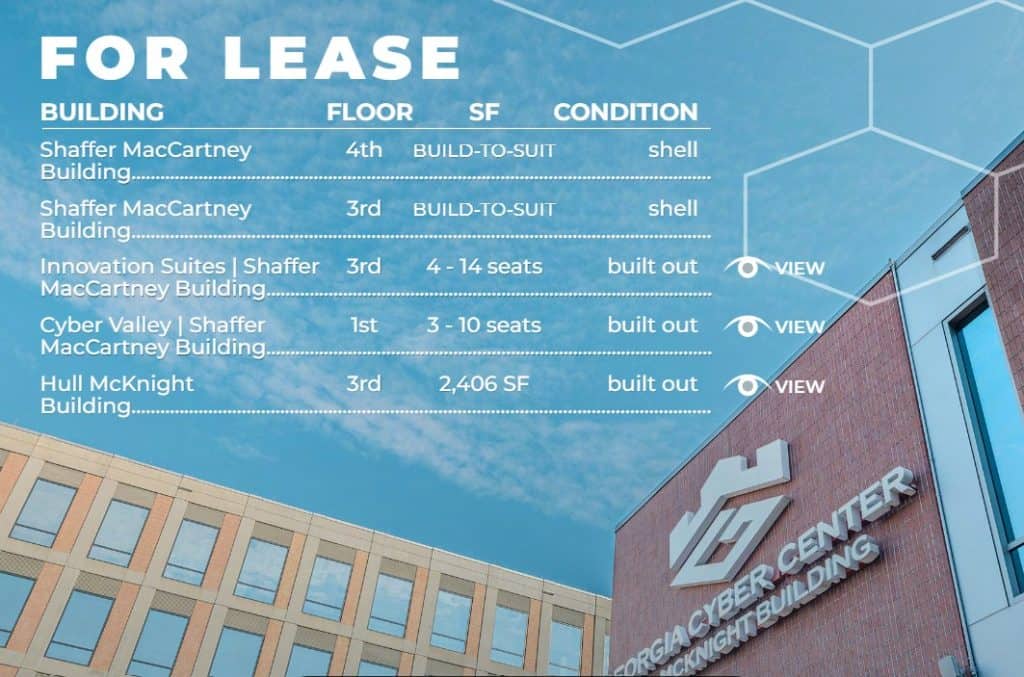
Currently, there are five different office space options in two buildings. For pricing structures, companies are asked to click here to start the conversation.
Among the systems available at GCITC is The Cyber Range. That is a private, cloud computing environment not connected to the GCITC network. It supports both research and training.
“We load up whatever that exercise may be. Frequently, we create that exercise given parameters provided by the end user, and so we tailor it to the end user, and they’re able to deliver a tabletop exercise,” explained Dennis. “Usually, it’s a teaching moment. It may be in real time, our guys are able to go add those elements in, or it may be a month or a quarter or half a year later, they do another exercise with that capability added in.”
Augusta University’s Security Operations Center (SOC) is also based in GCITC. It opened in October 2020 to address challenges that developed during COVID-19 and increased cybersecurity needs. It is a rich environment training students for high-level positions.
“It’s a real slick presentation up there, but the other part of it is the things they have those students doing are unbelievable,” said Dennis. “So, those students go, and they knock on the door of the NSA or of NASA. Interesting thing about students at Augusta University in that program is that a lot of them really do want to stay local, and there are plenty of opportunities for them here locally.”
That level of training makes GCITC a fertile ground for companies offering internships and students needing the experience. It is another selling point for leasing office space. Students are further along in their education and looking for a jumping-off point.
“With the exception of Augusta Tech students, there are no freshmen or sophomores on this campus,” Dennis said. “It’s the junior, senior, and graduate students that are on this campus, and it’s those students that typically are doing the internships here. I think there are about 120 interns that are doing work on this campus. A lot of them are with Peraton or Steelgate.”

The most recently announced tenant, at first blush, does not appear to meet the criteria of a business rooted in the cyber technology or cybersecurity ecosystem. The National Wild Turkey Federation (NWTF), based in Edgefield County, is opening a satellite office.
“When that first percolated and someone said wild turkeys are going in, there were all the jokes that come with the alcohol,” quipped Dennis, who turned serious, adding that the reason an organization more closely associated with outdoor activities is setting up an office fits in with the overall mission.
NWTF co-CEO Jason Burckhalter told ABD they want to lean into innovation, with technology and artificial intelligence being a key component.
“We saw an opportunity to open up a small satellite office there and put our web development team and our data team there so they could just mingle and be around other bright individuals and just collaborate and come up with innovative concepts to advance the NWTF,” he said.
“I buy into their mission, 100%. Conservation and everything else, and they needed that service,” Dennis said. “I think as we open up the aperture and we realize there are folks who are interested in that and require that we want to be good community partners.”