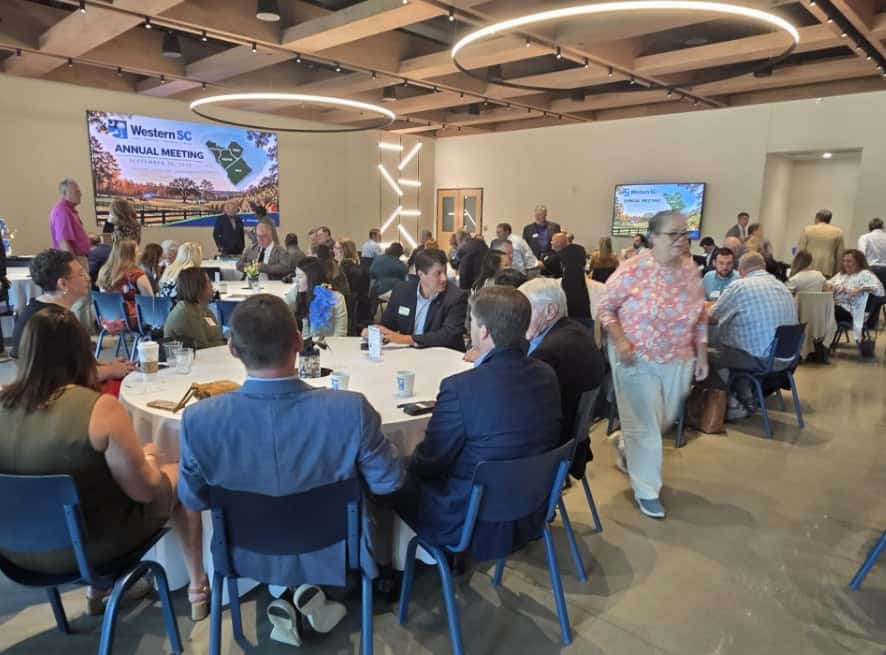
Leaders in business, government, and education gathered for a report on economic development in a four-county region in the CSRA.
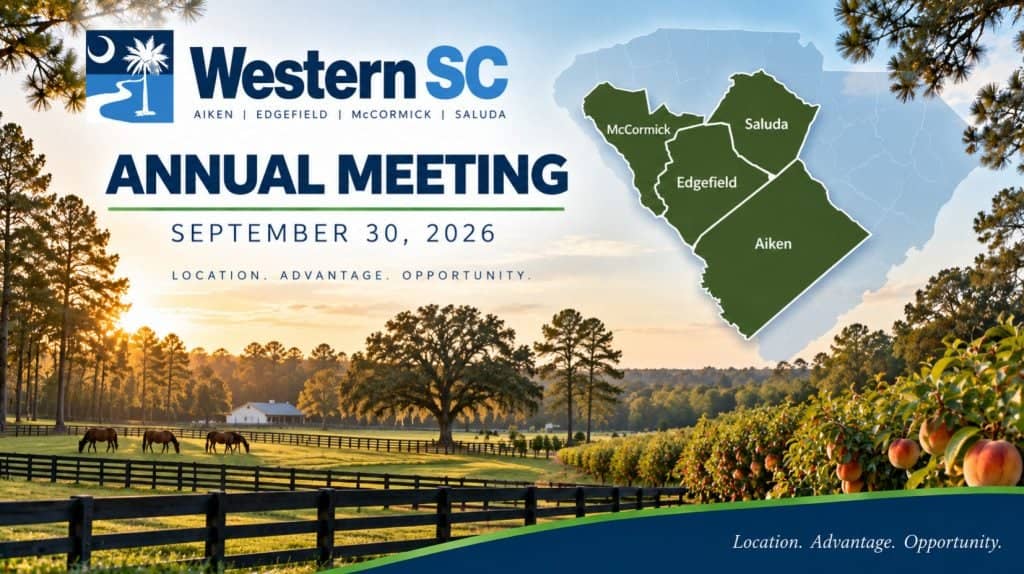
Organized by Western SC Economic Development Partnership, the annual meeting is the organization’s opportunity to report and listen. Western SC advocates for Aiken, Edgefield, McCormick and Saluda counties.
Will Williams, president and CEO of Western SC, told ABD that, on the whole, the region is doing well.
“Our county leadership has invested in making sure we’re trying to get our sites better and better and more prepared,” he said. “But it’s a marathon and not a sprint, so you just got to stay at it. But then there are some things that we, as economic developers or county council members, have no authority of, so I hope there’ll be some looking at property taxes compared to Georgia and North Carolina.”
Philip Wahl, CEO of Security Federal Bank, was among the business leaders in the audience of more than 100 people. He said the information is particularly helpful for the banking industry.
“This is a leading economic indicator for us, and as we obviously headquarter here, we want to be a part of every opportunity there is, whether it be borrowing or deposits or somebody’s individual financial needs. This is the brain trusted here,” he said.
The guest speaker was Beth Land, president and founder of Land Strategies, who has more than 12 years of experience in site selection. She launched a website called LandWise as an educational platform to help economic developers, elected officials, and stakeholders train on economic development.
“I’m here today to explore some of those concepts,” she said. “I don’t try to prescribe a methodology on what you should do in your community because I think elected leaders should have their own vision. This is more ow economic development works. This is how money flows. This is how tax revenue works. This is how some of the incentive mechanisms work, so that people have more context.”
As a native of York County, just south of Charlotte, Lane understands the unique needs of a border community.
“Number one, working in the public sector just south of Charlotte, helps me understand how people think about decisions and trade-offs, and what the resources are between two different states,” she said. “How do they work together? How do they not work together? A lot of times, workforce assets are regional, so it’s important to understand how political boundaries don’t mean that regional assets can’t cross them.”
The needs of workforce assets hit a top note with Dr. Forest Mahan, president of Aiken Technical College. It helps them look at trends in this area and respond accordingly.
“We need to make sure that we’re keeping an eye on the larger region about economic development,” he said. “It helps us keep up with what the workforce needs are and how they’re evolving. It gives us an opportunity to assess what our current programs are, and if there are opportunities for new programs to meet the increasing needs and demands for the workforce pipeline.”
That regional approach is also important for both South Carolina and Georgia, said Jim Tunison, president and CEO of the Aiken Chamber of Commerce.
“It’s important because I don’t think people realize everything that our county in this region has going on, the capital investment that is taking place here,” said Tunison. “It’s important for the business community and community at large to understand and really get a picture of what’s coming down the pipeline for our region.”
Williams echoed the value of the regional approach, saying companies want to locate where they can find employees, where operating and logistics expenses are viable, and where there is the lowest amount of risk.