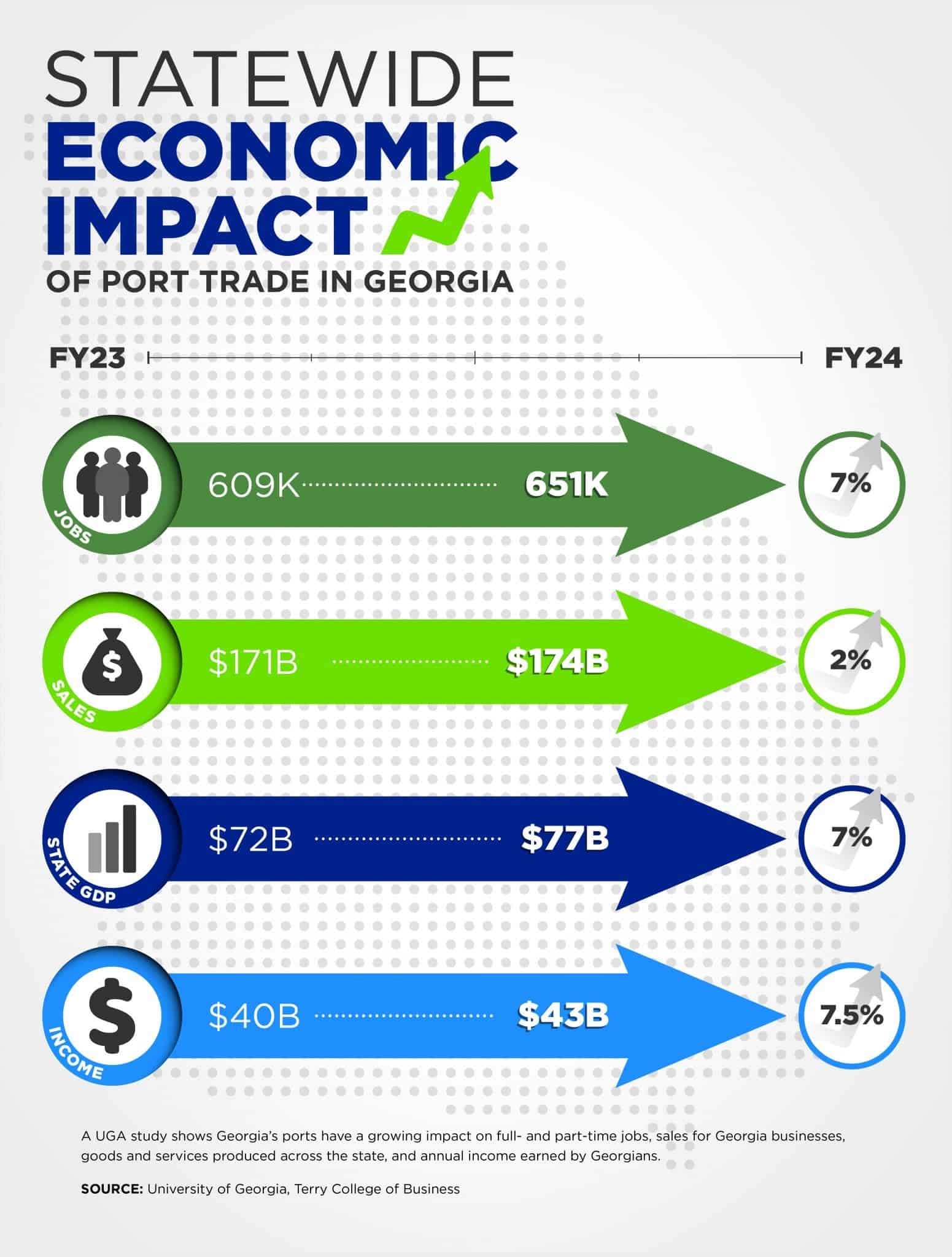
Late last week, members of the Metro Augusta business community learned Georgia’s deepwater ports are a major driver of the state’s economy, accounting for $77 billion of the state’s Gross Domestic Product (GDP). That is 9% of Georgia’s total GDP.
An Augusta Professor of Supply Chain Management and Operations says there are many benefits for local manufacturers and businesses to import and export their products through Savannah and Brunswick.
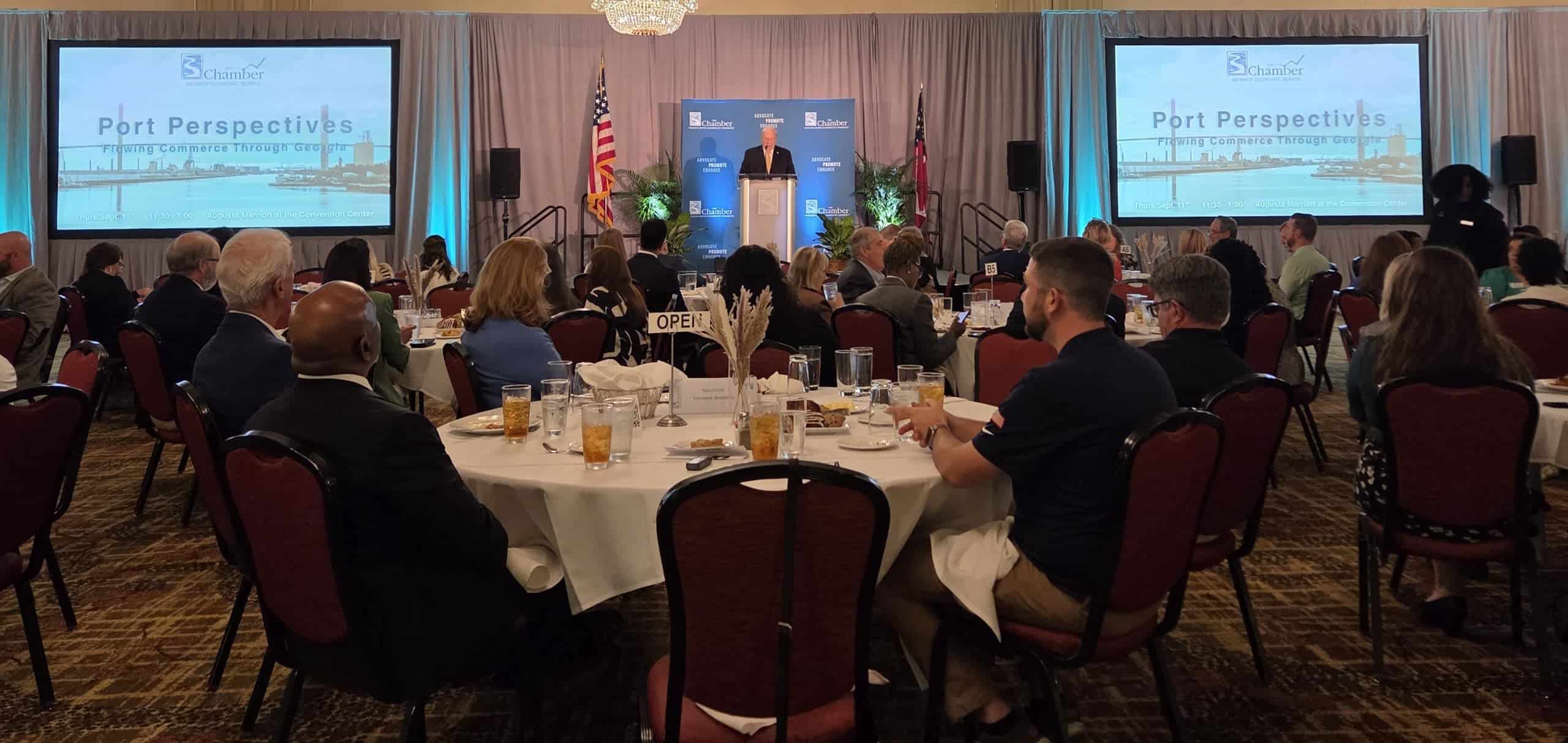
Fabio Batista, Chief Commercial Officer for the Georgia Ports Authority (GPA), spoke at the September Member Economic Luncheon sponsored by the Metro Augusta Chamber of Commerce. He told attendees that GPA has committed $260 million to continue growing capacity at the ports.

“It worked for the Georgia ports, but of course, it worked for all the ocean carriers,” he said. “As part of that investment, we’re building another berth. So, the business is growing a lot. We got the number one position, biggest port in the country, but if we’re going to keep that position, we need to grow.”
There are two state-owned ports, the Port of Savannah and the Port of Brunswick, as well as private marine terminals.
Rick Franza, an AU Hull College of Business Professor, says Augusta manufacturers have used the ports in the past, but encourages other CSRA businesses to do the same. “They may be able to cut their supply chain costs, increase the speed of delivery, and have access to more market suppliers.”
“A recent study by the University of Georgia’s (UGA) Terry College of Business broke down the impact the ports have across multiple economic sectors in FY2024:
- $174 billion in sales (11 percent of Georgia’s total sales)
- $77 billion in state GDP (9 percent of Georgia’s total GDP)
- $43 billion in income (7 percent of Georgia’s total personal income)
- 650,964 full- and part-time jobs (12 percent of Georgia’s total employment)
- $10 billion in federal taxes
- $3 billion in state taxes
- $3 billion in local taxes
“There is also money available to area companies through the Port Activity Tax Credit,” added Franza. If interested, businesses should consult the websites of the Georgia Department of Revenue and the Georgia Department of Revenue, and your tax professional to review the qualifications.
MORE STATEWIDE EXPANSION
Batista said one challenge being faced by the Georgia ports is that ships are getting larger.
“As the ships are getting bigger, we need more depth, need more width (in the Savannah River),” he explained. “So, we’re working on a project to deepen the port and in the river, widening the river. But this will take years, six, probably eight years, until that’s all done.”
The UGA study found that container traffic has the largest economic impact. Containerized cargo accounts for 94%, with auto/vehicle cargo accounts adding 4% and about 1% from dry bulk accounts.
Batista said one way the Georgia ports remain competitive is their ability to provide warehouse storage space.
“We are probably one of the best in the southeast. It’s a very large facility. We also most recently built or expanded a local storage facility for customers,” he said. “They can keep those containers in Savannah. Once they are ready, they could come out to their warehouse. And we are also one of the few ports in the county with the rail facility.”
That rail facility provides the GPA with access to its inland port system, supporting the state’s agriculture and forestry industries. The network includes the Appalachian Regional Port (ARP) located in Murray County, the Blue Ridge Connector, a planned 104-acre rail terminal in Hall County, and the Bainbridge Terminal on the Apalachicola-Chattahoochee-Flint Waterway in Southwest Georgia.
He said tariffs are beginning to have an impact on business at the ports. We’ll take a closer look at that, and the latest report from the National Retail Federation, in part two.